HISTORICAL
Tehran, IranSep 19, 1976, 12:30 AM
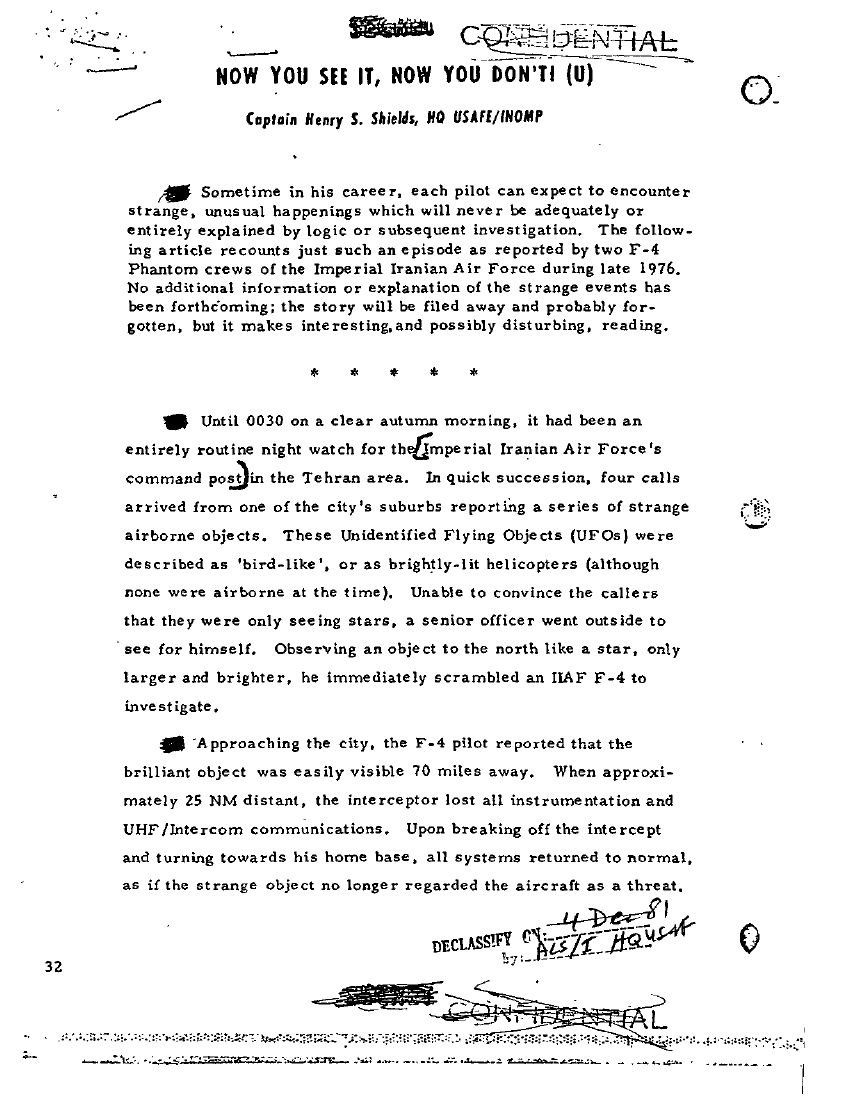
DIA report by Capt. Henry S. Shields (1976) · Public domain · via Wikimedia Commons
Shape · Disc
Duration · Minutes
1976 Tehran UFO incident — Two Imperial Iranian Air Force F-4 Phantom jets attempted to intercept a brilliant object over Tehran. Both jets lost instruments and weapons systems during the encounter, documented in a US DIA memo.
On the night of September 19, 1976, two Imperial Iranian Air Force F-4 Phantom II jets were scrambled from Shahrokhi Air Base near Hamadan to intercept a brilliantly lit object hovering over Tehran. Both interceptors experienced electronic failures when approaching the target, and the encounter became one of the most thoroughly documented military UFO cases ever released by a US ally.
【Background】
The Iranian Air Force command had received multiple calls from Tehran residents and air traffic controllers reporting an extraordinarily bright object over the capital. The first F-4, flown by Captain Mohammad Reza Azizkhani, was vectored toward the object. As it approached within 25 nautical miles, the aircraft's instrumentation and UHF/intercom communications failed simultaneously. Captain Azizkhani broke off the pursuit and the systems immediately returned.
【The Encounter】
A second F-4, commanded by Lieutenant Parviz Jafari, was launched and reacquired the object on radar. Jafari described the radar return as comparable in size to a Boeing 707 tanker. As Jafari prepared to fire an AIM-9 missile, his weapons system and radio went dead. A smaller secondary object was then seen to separate from the primary craft and approach his aircraft; Jafari attempted to fire a missile at it as well, but the launch was prevented by the systems failure. The primary object eventually accelerated away and disappeared.
【Investigation】
The US Defense Intelligence Agency obtained a detailed report from the IIAF and circulated it through American intelligence channels. The DIA document, declassified in 1977, was distributed to the White House, the Joint Chiefs of Staff, the CIA, the NSA, and other agencies. The DIA's covering memo rated the report as containing all "outstanding" qualities required for a credible UAP case, including multiple witnesses, ground/air radar, electronic interference, and trained military observers.
【Modern Assessment】
Skeptics have proposed Jupiter, an unusual meteor, or atmospheric phenomena as the trigger, but cannot account for the radar returns, the synchronised avionics and communications failures on two separate aircraft, or the visual descriptions. The Tehran case is frequently cited alongside the 2004 Nimitz tic-tac and 2014 Chilean Navy events as flagship aviation UAP encounters with multi-sensor military data.
Source: https://en.wikipedia.org/wiki/1976_Tehran_UFO_incident
35.6892°, 51.3890°
Source: Wikipedia
See this sighting on the map →