HISTORICAL
Nuremberg, GermanyApr 14, 1561, 05:00 AM
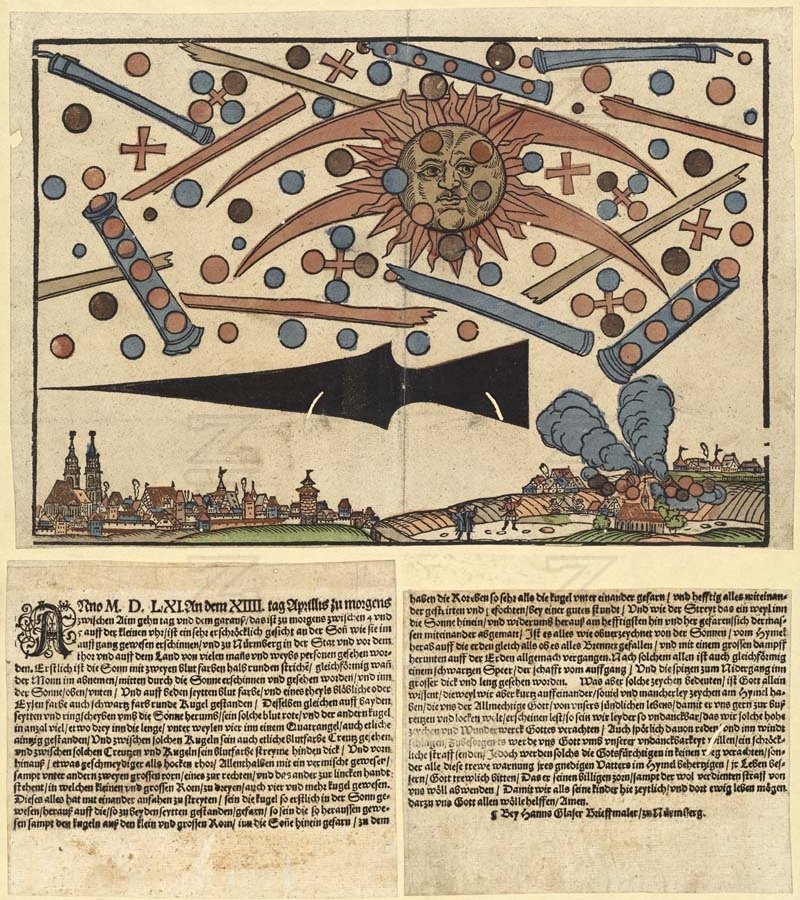
Broadsheet by Hanns Glaser (1561) · Public domain · via Wikimedia Commons
Shape · Unknown
Duration · 10+ min
Nuremberg celestial phenomenon — A 1561 broadsheet by Hans Glaser depicted an aerial battle over Nuremberg between cylinders, spheres and crosses. The woodcut is among the earliest mass-witnessed aerial phenomenon records in Europe.
At dawn on April 14, 1561, residents of the free imperial city of Nuremberg, in southern Germany, reported a sky-spanning display of cylindrical, spherical, and cross-shaped objects engaged in apparent combat over the city. The event was illustrated in a contemporary broadsheet woodcut by Hans Glaser and is one of the most-cited pre-modern alleged UFO observations.
【Background】
Nuremberg in 1561 was a major centre of Reformation-era German printing, with active broadsheet (Flugblatt) news production. Contemporary broadsheets routinely combined astronomical observations, religious interpretation, and sensational illustration. Hans Glaser was a regularly employed broadsheet illustrator.
【The Encounter】
Per the Glaser broadsheet, at sunrise on April 14 numerous men and women observed in the sky "a dreadful apparition" consisting of cylindrical "tubes" or "pipes" from which red, black, blue and orange globes emerged. The globes formed up into apparent groups and engaged in combat with one another for about an hour. After the fighting ceased, the objects fell to earth, where they "wasted away with immense smoke." A large dark spear-like object also appeared in the sky.
【Investigation】
The Glaser broadsheet has been studied by historians of science as an example of 16th-century atmospheric optics interpreted within Reformation eschatological imagery. Astronomical historian Frank Heller and others have argued that the appearance is consistent with a complex sun-dog or parhelion display — multiple solar halos and arcs produced by ice-crystal refraction at sunrise. This is supported by the timing (dawn) and the recurrence of similar Reformation-era broadsheets reporting "battles in the sky."
【Modern Assessment】
The case has been heavily popularised in modern UFO literature, but historians of science and meteorologists generally regard it as an atmospheric optical phenomenon recorded in 16th-century iconography — religious and political imagery being read into a natural display. The Glaser woodcut itself is held in the Wickiana collection in Zurich and is widely reproduced. Whether read as atmospheric optics or as a religious sign, the Nuremberg broadsheet remains the earliest broadly recognisable European example of sky observation framed in language a modern reader would recognise as UFO-adjacent.
Source: https://en.wikipedia.org/wiki/Celestial_phenomenon_over_Nuremberg
49.4521°, 11.0767°
Source: Wikipedia
See this sighting on the map →